This blog post was written for the module Enterprise IT (113601a).

Introduction
If you’ve ever spent hours staring at a screen and then suddenly everything “clicks”—you’re in the zone, the code just flows, and you forget to eat—then you know exactly what I mean by “the vibe.” In the world of Enterprise IT, we usually call this Developer Experience (DevEx) or a Flow State.
For a long time, big companies focused mostly on servers and hardware. But today, the real bottleneck isn’t the CPU; it’s the developer’s brain. “Vibe Coding”—using AI tools to stay in that flow—is becoming a huge deal. But here’s the thing: while getting the vibe is great for productivity, it’s a bit of a balancing act for large enterprises. How do we keep the speed without breaking security or creating a mess of technical debt? In this post, I’ll dive into why the vibe matters and how companies like IBM or Microsoft are trying to find the right balance.
Why the “Vibe” is Actually Science
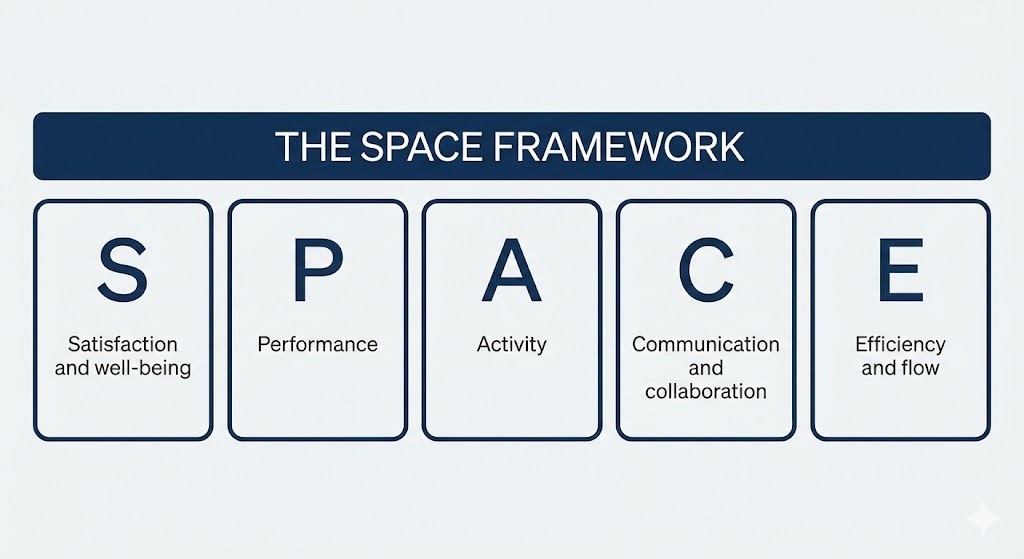
It might sound like a soft topic, but there’s a lot of research behind it. To measure how developers actually work, researchers came up with the SPACE Framework (Satisfaction, Performance, Activity, Communication, and Efficiency) [1].
The goal for any modern IT department should be to maximize these metrics. Why? Because happy developers who aren’t stuck in meetings or fighting slow build-tools are way more productive. McKinsey found that companies with high “Developer Velocity” grow their revenue four to five times faster than their competitors [2]. So, the “vibe” is literally a business strategy.
Opportunity: AI and Agentic Workflows
The biggest game-changer for my generation of developers is definitely AI. Tools like Cursor or GitHub Copilot (often called “Agentic AI”) are taking over the boring stuff.
- Less “Toil”: We don’t have to write boring boilerplate code anymore. The AI does it, and we stay in the creative flow [3].
- Fast Prototyping: You can build an MVP in a weekend that used to take weeks. IBM is seeing 30-40% faster development times because of this [4].
- Staying in the Zone: Every time you have to Google a small syntax error, you risk losing your flow. AI keeps you in the editor and in the “vibe.”
From “Writing” to “Orchestrating”: The Skill Shift
One thing I realized during my research is that “Vibe Coding” is changing what it means to be a developer. We are moving away from being just “coders” to being “System Orchestrators.”
In an enterprise context, you aren’t just typing lines; you are managing a team of AI agents. This is a huge opportunity because it allows us to focus on the Big Picture—architecture, user experience, and business logic. However, the risk here is “Abstraction Leaking.” If you don’t understand the underlying code the AI produces, you can’t fix it when it breaks. Enterprises need to invest in Upskilling, making sure developers don’t just know how to prompt, but also how to audit [8].
The Sustainable Vibe: Energy and Mental Health
We also need to talk about the “Dark Side” of the vibe. Keeping a high velocity is exhausting.
- Vibe Burnout: When you can code at 10x speed, the expectation for you to deliver at 10x speed follows. This can lead to massive pressure. A “Sustainable Vibe” means having periods of deep flow, but also periods of reflection and rest [10].
- Environmental Impact: Running large language models (LLMs) for every single line of code is energy-intensive. IBM and others are now looking into “Green AI”—optimizing models so that our “vibe” doesn’t come at the cost of the planet [9]. As students, we should be aware of the carbon footprint of the tools we use.

The Risks: When the Vibe Goes Wrong
But it’s not all perfect. Especially in a big company (Enterprise), “Vibe Coding” can lead to some serious headaches:
1. Technical Debt
When you’re moving fast with AI, it’s easy to ignore the “boring” stuff like documentation or clean architecture. Gartner warns that if we aren’t careful, we’ll end up with a huge pile of AI-generated code that nobody knows how to fix in two years [6].
2. Security and “Shadow IT”
If a company’s official tools are slow or annoying, developers will find their own ways—using unapproved AI tools or leaking sensitive data into public LLMs. For companies that have to follow GDPR or the new EU AI Act, this is a nightmare [7].
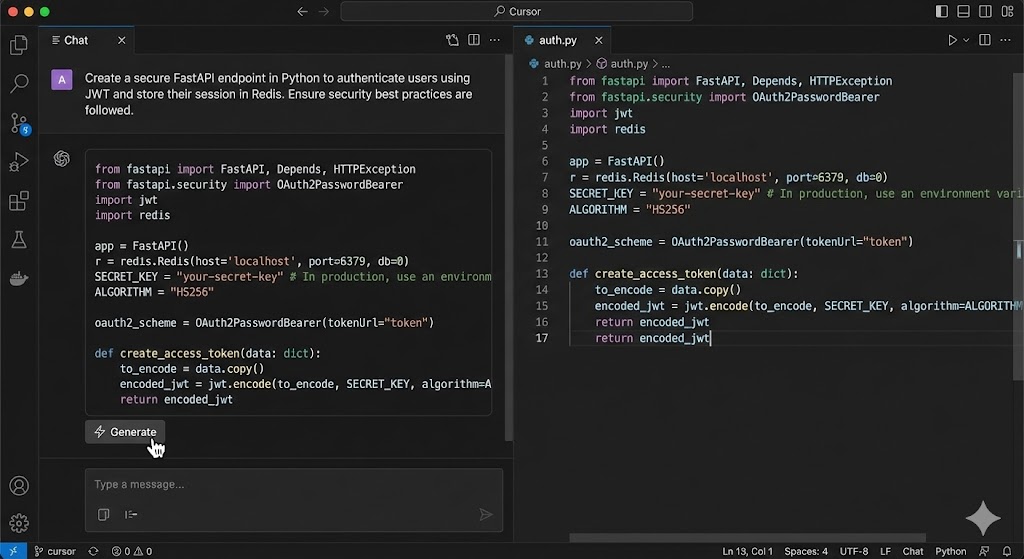
A perfect example of these risks can be seen in Figure 3. While the AI-agent generated a working FastAPI endpoint, it also hardcoded a SECRET_KEY. Although it added a comment to use environment variables, a developer in a high-speed ‘flow state’ might overlook this. If pushed to a public repository, this ‘vibe-coded’ shortcut would create a major security vulnerability.
3. Losing Deep Knowledge
If the AI does all the “thinking,” do we still understand our own systems? There’s a risk that we become too dependent on these tools and lose the ability to debug complex problems without help.
How to Balance It: “Guardrails as Code”
So, how do enterprises fix this without killing the vibe? The answer is Platform Engineering. Instead of giving developers a list of rules they’ll probably ignore, companies are building “Internal Developer Portals” (IDPs).
Think of it like a “Golden Path”: The company provides pre-configured templates that are already secure and compliant. You can still vibe and move fast, but you’re staying within the lines [4]. Zühlke, for example, uses peer reviews and pair programming to make sure that even if a developer “vibes” through a feature, another human has checked the logic [5].
| Feature | The “Vibe” (Opportunity) | The “Enterprise” (Risk) | The Balance (Solution) |
| Speed | Instant code generation via AI. | Slowed down by manual security checks. | Automated Guardrails in the CI/CD pipeline. |
| Creativity | Freedom to use any new tool/agent. | Strict “Approved Software” lists. | Internal Developer Portals with pre-vetted tools. |
| Quality | High velocity, but potential bugs. | High stability, but slow innovation. | Peer Reviews & AI-driven testing. |
Conclusion
“Getting the vibe” isn’t just a meme—it’s how modern software gets built. For us as students and future IT pros, the challenge is to use these new AI “agents” without getting lazy.
Large companies need to realize that you can’t force productivity with more meetings or stricter rules. You get it by creating an environment where developers can actually focus. The winners in the next few years will be the companies that find the sweet spot: giving developers the tools to stay in their flow, while using smart, automated guardrails to keep the enterprise safe.
References
[1] Forsgren, N., et al. (2021). The SPACE of Developer Productivity. ACM Queue. ACM Queue Study
[2] McKinsey & Company. (2024). Developer Velocity: Software Excellence & Business. McKinsey Report
[3] GitHub. (2024). The Economic Impact of the AI-Powered Developer. GitHub Blog
[4] IBM Institute for Business Value. (2025). Enterprise AI: Scaling Generative AI in Software Engineering. IBM Insights
[5] Zühlke Group. (2024). Engineering the Future: Balancing Agility and Stability. Zühlke Insights
[6] Gartner. (2024). Predicts 2024: AI Will Transformationally Change Software Engineering. Gartner Research
[7] European Parliament. (2024). The EU AI Act: Regulatory Framework for AI. Official EU AI Act
[8] Microsoft. (2025). The Future of DevEx: Agentic Workflows in the Enterprise. Microsoft WorkLab
[9] Wikipedia. (2025). Environmental impact of artificial intelligence. Wikipedia article
[10] [10] Trinkenreich, B., et al. (2023). A Model for Understanding and Reducing Developer Burnout. IEEE Xplore Library
Leave a Reply
You must be logged in to post a comment.